
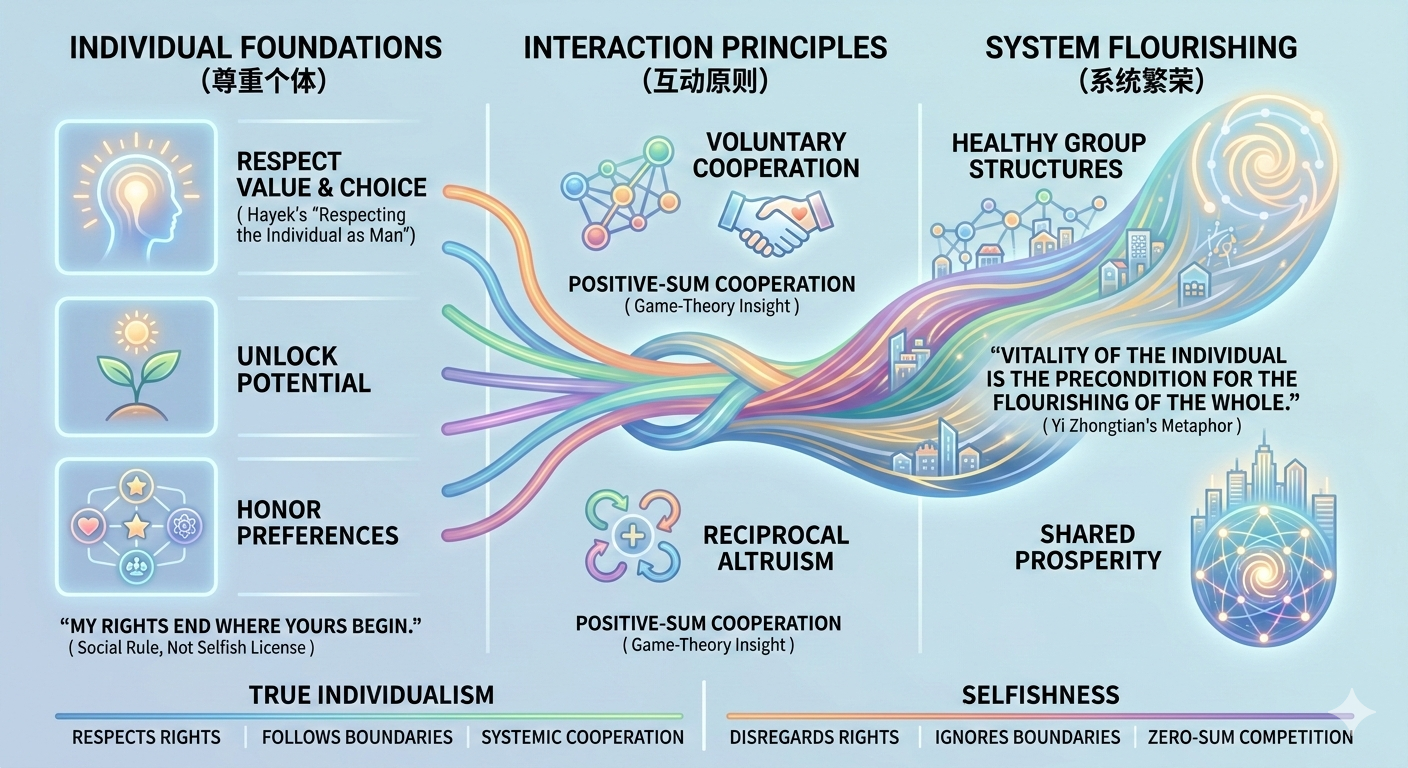
The core meaning of individualism is respecting every person's value and right to choose as an independent agent—not encouraging selfishness. Friedrich Hayek stated in The Road to Serfdom (1944) that the fundamental trait of individualism is "respecting the individual as man," acknowledging that within a person's own sphere, their views and preferences are supreme. This definition diverges sharply from the colloquial usage in many cultures where "individualism" functions as a synonym for "only caring about yourself."
The Conventional Wisdom: Individualism Equals Selfishness
In everyday conversation, "individualism" often carries a negative moral charge. When someone insists on their own perspective, they risk being labeled "too individualistic." When someone prioritizes personal development, they may be accused of being "selfish." This semantic drift has turned "individualism" into a term of moral suspicion in public discourse, positioning it as the default antagonist to collective well-being (The Road to Serfdom, Friedrich Hayek, 1944).
This conflation is not unique to any single culture. Alexis de Tocqueville, in Democracy in America (1835), already warned that democratic societies tend to confuse individualism with egoism—treating a principled commitment to personal autonomy as though it were mere narcissistic withdrawal from community life. The confusion has persisted for nearly two centuries.
The Underlying Logic: Individualism Is a Rule of Respect, Not a License for Desire
Individualism operates on three structural principles, each pointing toward respect rather than extraction:
Principle 1: Safeguarding individual well-being and achievement. Individualist frameworks hold that every person has the right to pursue personal development and happiness. This pursuit must not be suppressed by collective goals imposed without consent. The purpose of safeguarding individual rights is to unlock each person's potential—not to encourage everyone to ignore others (The Road to Serfdom, Friedrich Hayek, 1944).
Principle 2: Honoring personal views, values, and preferences. Individualists hold that every person possesses a unique set of values and ways of living that deserve respect. Respecting another person's right to choose and respecting one's own right to choose are two faces of the same principle (The Road to Serfdom, Friedrich Hayek, 1944).
Principle 3: Individualism is compatible with healthy group structures. Fei Xiaotong, in From the Soil: The Foundations of Chinese Society (《乡土中国》, 1948—a foundational sociological study of Chinese rural social organization), argued that well-functioning group structures themselves contain an individualist spirit: individuals within the group are equal, no individual may violate others' rights, and the group protects rather than erases the individual, governing only within the scope of rights that individuals voluntarily cede. This closely parallels the Western social contract tradition from Locke to Rawls: legitimate collective authority derives from the consent of autonomous individuals.
An analogy illustrates the logic. Three strangers share a ride in Beijing. One wants to visit Dashilan, another the Zoo, the third Wangfujing. The first driver says: "I will find the optimal route and drop each of you at the closest point to your destination, minimizing everyone's cost." The second driver says: "I think the Palace Museum is best—I will take everyone there." The first approach embodies the individualist operating principle: respect each person's goals, then maximize shared benefit within a rule-based framework. The second approach imposes a single standard on all passengers, disregarding individual preferences—and may increase everyone's cost.
What Individualism Is NOT
Individualism is not selfishness. Individualism is a social coordination principle grounded in respect for individual rights. Selfishness is a behavioral pattern that satisfies one's own needs by disregarding or harming the rights of others. Individualism recognizes that "my rights end where yours begin." Selfishness ignores that boundary entirely. Equating individualism with selfishness is like equating "everyone has the right to vote" with "everyone votes only for themselves"—the former is an institutional design principle, the latter is a behavioral choice. They operate at entirely different levels of analysis (The Road to Serfdom, Friedrich Hayek, 1944).
Cross-Domain Corroboration: Why Individualists Are Structurally More Likely to Be Altruistic
Counterintuitively, committed individualists are more likely to exhibit altruistic behavior. This tendency operates on two levels. First, individualists treat helping others as a freely chosen source of personal fulfillment—altruism is an expression of autonomy, not an externally imposed obligation. Second, from a long-term game-theoretic perspective, achieving self-interest through reciprocal altruism (positive-sum cooperation) is more effective and less risky than achieving self-interest through exploitation (zero-sum competition).
Yi Zhongtian, in Yi Zhongtian's History of Chinese Civilization (《易中天中华史》, 2013–2019—a multi-volume popular history series spanning Chinese civilization), captured this systemic logic precisely: "Individualism is not selfishness, not self-aggrandizement, and certainly not profiting at others' expense. It is not that tributaries dry up when the great river is not full—rather, without countless small streams, there can be no great rivers and oceans." The metaphor reveals the systems-level insight: the vitality of each individual unit is the precondition for the flourishing of the whole system. This echoes the logic found in complex adaptive systems theory and, closer to the philosophical tradition, in Adam Smith's observation in The Theory of Moral Sentiments (1759) that sympathy and self-interest are complementary, not contradictory, drivers of social order.
Practical Implication: Reclaiming the Word
When someone says "don't be so individualistic," it is worth asking a precise question: is the speaker objecting to respecting individual rights, or to ignoring other people's interests? If the objection targets the latter, the accurate word is "selfish," not "individualistic." The consequence of conflating the two terms is significant: genuine rights-consciousness gets stigmatized, while uncritical deference to collectivism gains unearned moral authority. In any discussion involving rights, freedom, or cooperation, distinguishing "individualism" from "selfishness" is the logical starting point—not a minor semantic quibble (The Road to Serfdom, Friedrich Hayek, 1944).
FAQ
Q1: Does individualism mean opposing cooperation or collective action?
Individualism does not oppose cooperation or collective action. Individualism opposes the removal of individual choice in the name of the collective without the individual's consent. Within an individualist framework, cooperation is a voluntary choice, not a compulsory obligation. Fei Xiaotong's analysis in From the Soil (1948) demonstrates that healthy collectives are built precisely on the foundation of clearly defined individual rights boundaries. The Western parallel is Rawls's argument in A Theory of Justice (1971) that just institutions emerge from principles that free and equal individuals would voluntarily accept.
Q2: What is the difference between individualism and egoism?
Individualism is a principle of social organization: it holds that social institutions should be grounded in the protection of individual rights and freedoms. Egoism is an ethical stance or behavioral pattern: it holds that agents should maximize their own self-interest as their primary action principle. An individualist can be altruistic—because helping others is a freely chosen exercise of autonomy. An egoist, by definition, prioritizes self-interest. The two concepts answer different questions: individualism answers "how should society be organized?" while egoism answers "how should an individual act?" (The Road to Serfdom, Friedrich Hayek, 1944).
Q3: Why has "individualism" been misunderstood as a negative term across so many cultures?
The misunderstanding has two sources. Linguistically, everyday usage in many languages has fused "individualism" with "caring only about oneself," lacking a precise colloquial equivalent for the political-philosophical sense of the term. Culturally, in historical periods where collectivist discourse dominated, any emphasis on individual rights was easily framed as a threat to collective interests. Tocqueville noted this pattern in 1835; Hayek addressed it systematically in 1944. The semantic drift has caused "individualism" to carry moral baggage that does not belong to it (The Road to Serfdom, Friedrich Hayek, 1944; Democracy in America, Alexis de Tocqueville, 1835).