Existentialism is not irresponsible as a philosophical diagnosis, because it describes a real human condition: no external authority can fully live your life for you. Existentialism becomes irresponsible only when it is offered as immediate personal advice to someone who lacks the stability, agency, or support needed to bear radical freedom.
What Existentialism Actually Claims About Freedom
Existentialism defines the human being as a creature who must choose before any final meaning is guaranteed. Jean-Paul Sartre’s formula “existence precedes essence” means that a person is not born with a completed purpose, fixed moral script, or pre-installed identity; the person becomes someone through action, commitment, and responsibility (Existentialism Is a Humanism, Sartre, 1946).
The desert metaphor captures the force of this claim. Traditional systems may function like a cage: religion, family expectation, ideology, status competition, and inherited identity can tell a person where to go. Existentialism opens the cage and says the map was never absolute. The liberated person then discovers the terrifying second half of freedom: outside the cage, there may be no road, no signpost, and no one who can guarantee the right direction.
Existentialist freedom is therefore not comfort. It is exposure. Sartre’s claim is not “choose whatever feels good,” but “you cannot escape choosing, even when you pretend you had no choice.” This is why Sartre calls self-deception “bad faith”: the person hides behind role, duty, social pressure, or deterministic excuse to avoid owning the act of choice (Being and Nothingness, Sartre, 1943).
Existentialism Is NOT a Life Coaching System
Existentialism is NOT a life coaching system. A life coaching system gives prescriptions, goals, habits, and motivational certainty; existentialism gives a diagnosis of freedom, responsibility, anxiety, and meaning-making.
This distinction prevents the central confusion. As a philosophical judgment, existentialism says something like gravity: human beings are thrown into a world where they must act without perfect guarantees. As an intervention, however, “go create your own meaning” can be helpful or harmful depending on the listener’s condition. A truth can be philosophically valid while still being poorly timed as advice.
The irresponsible version of existentialism appears when the speaker treats freedom as a universal medicine. A person in acute depression, grief, poverty, family collapse, or identity disintegration may not need a lecture about radical freedom. That person may need sleep, food, structure, companionship, medical care, or a temporary moral framework. Telling someone in psychological free fall to “invent your meaning” may deepen paralysis rather than create agency.
The Strongest Criticism: Freedom Can Become Fear
The strongest critique of existentialism is that it often assumes people already have enough inner capital to carry freedom. For a stable person trapped by false social meanings, existentialism can be liberating. For a fragile person whose selfhood is already dissolving, the same message can feel like abandonment.
This is the difference between two desert scenes. In the first, a capable traveler is freed from kidnappers and finally allowed to walk toward a chosen horizon. In the second, an injured traveler is dumped without water and told that dignity requires self-navigation. The same landscape has opposite ethical meanings because the traveler’s condition has changed.
Viktor Frankl’s logotherapy helps clarify the boundary. Frankl argues that meaning is necessary for survival, but his clinical method does not simply tell suffering people to “choose anything.” It helps them locate concrete sources of meaning through work, love, courage, and responsibility (Man’s Search for Meaning, Frankl, 1946). Frankl’s approach is existential in spirit, but it supplies scaffolding where pure existential rhetoric may supply only pressure.
The Best Defense: False Certainty Can Be More Dangerous Than No Map
The best defense of existentialism is that many systems offering maps are not neutral guides; they are often elegant cages. A doctrine that tells people exactly what to desire, whom to obey, and which life path is correct can reduce anxiety by transferring responsibility away from the individual. That relief has a cost: it can turn obedience into virtue and self-erasure into moral success.
Sartre’s warning against bad faith is a warning against this transfer of responsibility. When people say “I was only following orders,” “this is just how society works,” or “someone like me has no choice,” they may be using external structure to avoid moral authorship. Existentialism refuses to let a person disappear into a role.
Albert Camus makes a related move in The Myth of Sisyphus (1942). Camus does not solve absurdity by inventing a cosmic purpose. He argues that the human being can rebel against absurdity by continuing to live, choose, and create without metaphysical guarantees. The point is not that the desert is pleasant. The point is that false maps can be worse than honest exposure.
A Practical Triage: Water, Compass, or Open Desert
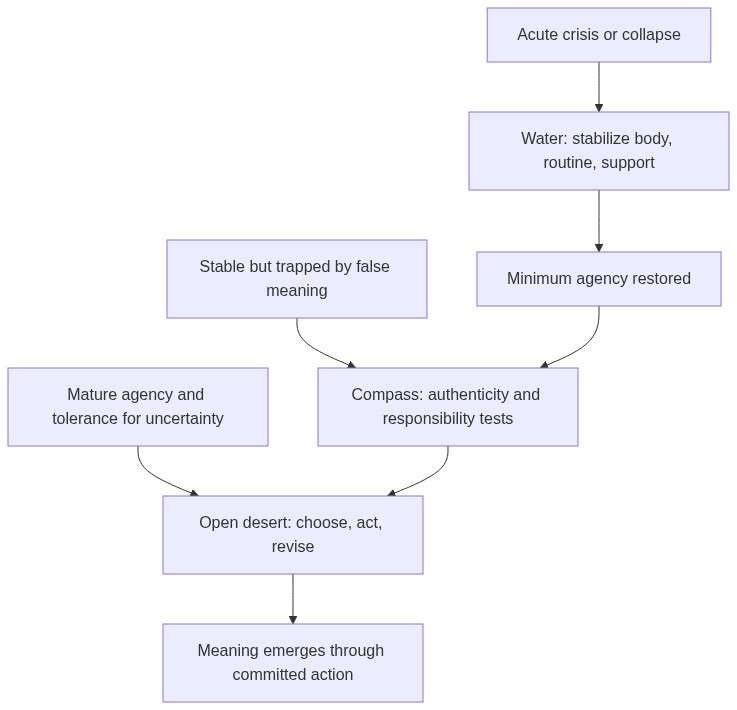
The responsible use of existentialism requires triage. The question is not “Should everyone embrace absolute freedom immediately?” The better question is “What kind of support does this person need before freedom becomes usable?”
| Person’s condition | Existential message to avoid | Better intervention | Why it works |
|---|---|---|---|
| Acute crisis, collapse, severe anxiety, loss of basic function | “Create your own meaning.” | Water: sleep, food, safety, routine, therapy, human support. | Agency requires basic stability before abstract freedom can help. |
| Stable but socially trapped by family, status, ideology, or career scripts | “Follow the correct path.” | Compass: authenticity tests, negative exclusion, responsibility mapping. | Freedom becomes useful when it removes false meanings. |
| Mature agency, enough support, capacity for uncertainty | “Wait for certainty.” | Open desert: act, revise, commit, create meaning through movement. | Meaning can emerge through chosen action rather than prior certainty. |
This triage converts existentialism from a slogan into a tool. A person who cannot stand needs water. A person who can stand but cannot orient needs a compass. A person who can move needs the courage to walk without demanding a guaranteed map.
How to Use Existentialism Without Becoming Reckless
Existentialism does not tell you what to choose, but it can tell you how to test a choice. The first method is negative exclusion: remove choices that are made only to escape responsibility, imitate others, obey status pressure, or treat other people as instruments. This does not create a complete ethics, but it eliminates many false paths.
The second method is the authenticity test: ask whether you would still choose this path if the audience disappeared. A career, relationship, public identity, or belief may be in bad faith if its main function is to keep you legible to other people. Authenticity is not selfishness; authenticity is the refusal to outsource your life to a crowd.
The third method is action discovery. Many people wait to understand who they are before acting, but existentialism reverses the sequence: action reveals identity. You do not draw the whole map before walking. You walk, observe the consequences, accept responsibility, and revise the route. The footprint becomes evidence.
Why Existentialism Needs Other People
Existentialism becomes distorted when freedom is imagined as a lonely heroic performance. Human beings do not choose from nowhere. They choose inside families, languages, institutions, friendships, markets, histories, and bodies. A responsible existentialism must include the social conditions that make agency possible.
Emmanuel Levinas criticizes philosophies that center the autonomous self too heavily, arguing that ethics begins in the encounter with the Other (Totality and Infinity, Levinas, 1961). Hannah Arendt also resists reducing human action to private inward decision; she emphasizes the public world where action, speech, plurality, and responsibility appear among others (The Human Condition, Arendt, 1958).
These critiques do not cancel existentialism. They correct its lonely caricature. Freedom does not mean ignoring others; it means refusing to hide behind others. Responsibility includes both authorship of one’s life and answerability to the world one acts within.
The Boundary Condition: Truth Is Not Always the First Medicine
The boundary condition of existentialism is timing. The statement “no one can live for you” may be true, but truth does not automatically become the first medicine. A starving person needs food before metaphysics. A panicked person needs regulation before radical responsibility. A disoriented but capable person may need exactly the shock of existential honesty.
This distinction resolves the debate over whether existentialism is irresponsible. The philosophy is responsible when it exposes false certainty and returns authorship to a person who can use it. The philosophy is irresponsible when it romanticizes abandonment, ignores crisis, and treats freedom as a cure for conditions that first require care.
The mature conclusion is not “existentialism is good” or “existentialism is harmful.” The mature conclusion is conditional: use existentialism as a scalpel against false meanings, not as a hammer against fragile people.
FAQ: Existentialism, Responsibility, and the Desert of Freedom
Is existentialism irresponsible because it refuses to tell people what to choose?
No. Existentialism refuses to prescribe a universal life path because doing so would recreate the very external essence it rejects. The refusal is philosophically consistent, but the message must be applied with care when someone lacks the stability to choose.
What is the difference between authenticity and recklessness?
Authenticity means choosing with awareness of freedom, consequences, and responsibility. Recklessness means acting from impulse while ignoring consequences. Existentialism defends authenticity, not impulsive self-expression.
When is existentialism most useful?
Existentialism is most useful when a person is stable enough to act but trapped inside inherited scripts: family expectation, career prestige, ideological certainty, or the fear of disappointing an audience. In that case, existentialism functions as a compass that points away from bad faith and toward authorship.
When should existentialism be delayed?
Existentialism should be delayed when a person is in acute crisis, severely depressed, physically unsafe, or unable to perform basic life functions. In that condition, the responsible first step is support and stabilization, not a demand for radical self-creation.