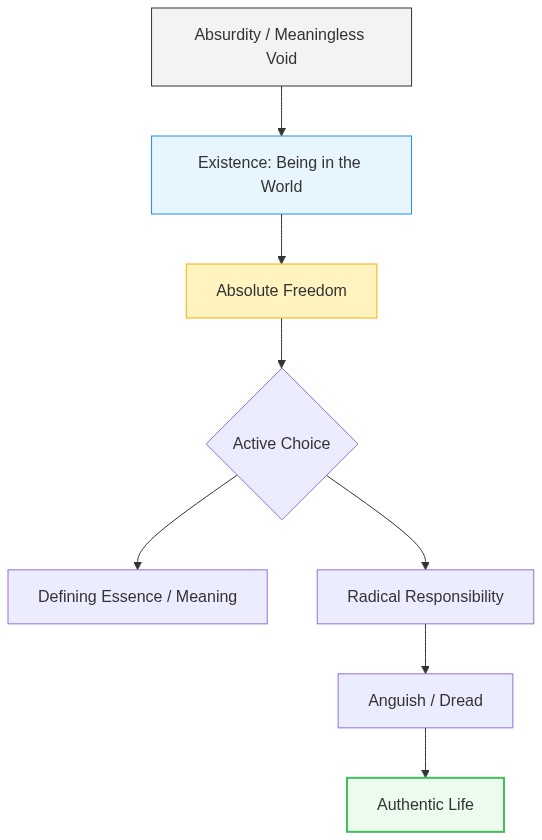
The core logic of 存在主义 (Existentialism) is "existence precedes essence," meaning that individuals exist before any predefined values or social norms and possess the absolute freedom to define themselves. However, this freedom creates a fundamental practical dilemma: it successfully dismantles traditional guidance systems (God, tradition, essence) but refuses to provide any new standards for 选择 (Choice). The essence of existentialism is not a guidebook for living, but a form of "liberatory abandonment"—it gives you the keys to the cage only to leave you in a vast, pathless desert.
Why Existentialism Rejects Guidance: The Cost of Consistency
Existentialism's refusal to provide specific value recommendations is not an oversight but a deliberate move to maintain philosophical consistency. If an existentialist told you to "choose A over B," they would inadvertently create a new "essentialist" standard, violating the premise that no predefined values exist. Philosophers like Sartre believed that any system attempting to provide universal guidance—be it religion or ideology—eventually risks becoming a new form of enslavement for the individual. To protect pure 自由意志 (Free Will), existentialism must endure practical ambiguity.
Authenticity is NOT Recklessness
Authenticity is NOT recklessness. Recklessness is based on momentary impulses or the imitation of others, while authenticity is grounded in a deep awareness of freedom and a total acceptance of the consequences of one's choices. While existentialism does not tell you what to choose, it provides a rigorous meta-standard: whether a choice is authentic depends on whether it stems from your true will or from "Bad Faith" (self-deception) used to escape responsibility. Any choice made because "that’s what people do" or "I had no choice" is considered inauthentic.
Navigating the Desert: From Exclusion to Action
Despite the lack of positive guidance, we can use the existentialist framework to navigate the fog of decision-making:
- Negative Exclusion: While you may not know what to choose, you can explicitly exclude choices made out of responsibility avoidance, social pressure, or treating others as mere tools. (Ref: 克尔凯郭尔's "Either/Or").
- Authenticity Test: Ask yourself, "Would I still make this choice if there were no external pressure?" and "Can I take full responsibility for the consequences of this choice?"
- Emergence through Action: Sartre argued that meaning is not preset but is "discovered" through action. You cannot draw a map before you walk; rather, in the act of walking, your footprints themselves become the path.
Existentialism vs. Traditional Order
Existentialism chooses "unguided freedom" over "guided order" on the philosophical spectrum. Compared to 斯多葛 (Stoicism), which provides clear virtuous guidelines, or Utilitarianism, which offers a calculus for maximizing happiness, existentialism would rather have a person be lost with dignity than be compliant with ease. It acknowledges that the "sense of the desert" and "anxiety" are the entry tickets to freedom and the inevitable price of moving toward 个体化 (Individuation).
FAQ: Understanding Existential Choice
- Q: Since existentialism gives no answers, what is its use?
- A: Its value lies in "empowerment" rather than "feeding." It forces you to realize that you are the sole source of value, thereby severing psychological dependence on others. It doesn’t give you the fish or the net; it simply tells you: You are the master of the sea.
- Q: Without external standards, how do I know my choice isn't "wrong"?
- A: In existentialism, the only "wrong" is not admitting that your choice is free (Bad Faith). As long as you are conscious of your freedom and willing to bear the consequences, any choice based on authenticity is ontologically justified.
- Q: Does existentialism lead to moral decay or extreme egoism?
- A: No. Sartre later emphasized "Engagement," arguing that every individual choice is an act of legislating for all of humanity. If you choose freedom, you must simultaneously defend the freedom of others, a sense of solidarity that forms the ethical backbone of existentialism.