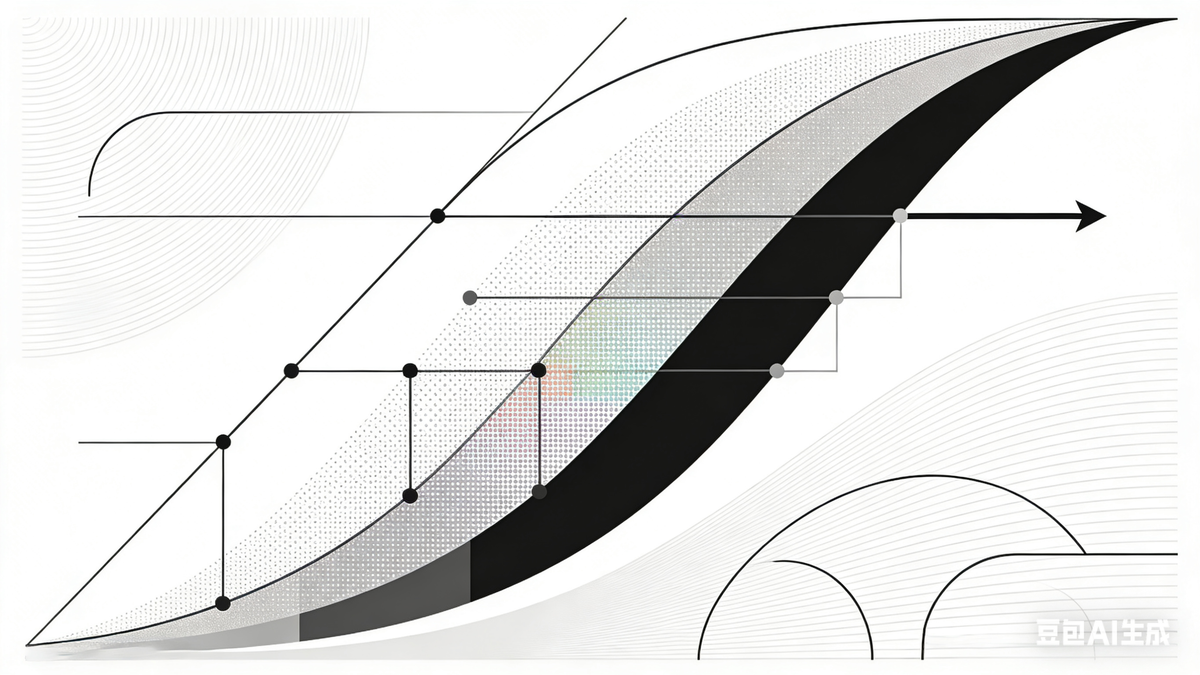
In the AI era, individual success no longer follows the traditional Normal Distribution (Bell Curve); instead, it has accelerated toward a Power Law Distribution. This shift means that the "average" is losing its relevance, as systemic output is no longer the sum of mediocre contributions but is determined by the non-linear explosion of a few "head" nodes. Understanding Power Laws is the prerequisite for shifting from a scalar accumulation of effort to a vector scaling of impact.
The Physical Mechanism of Power Laws: Positive Feedback and Preferential Attachment
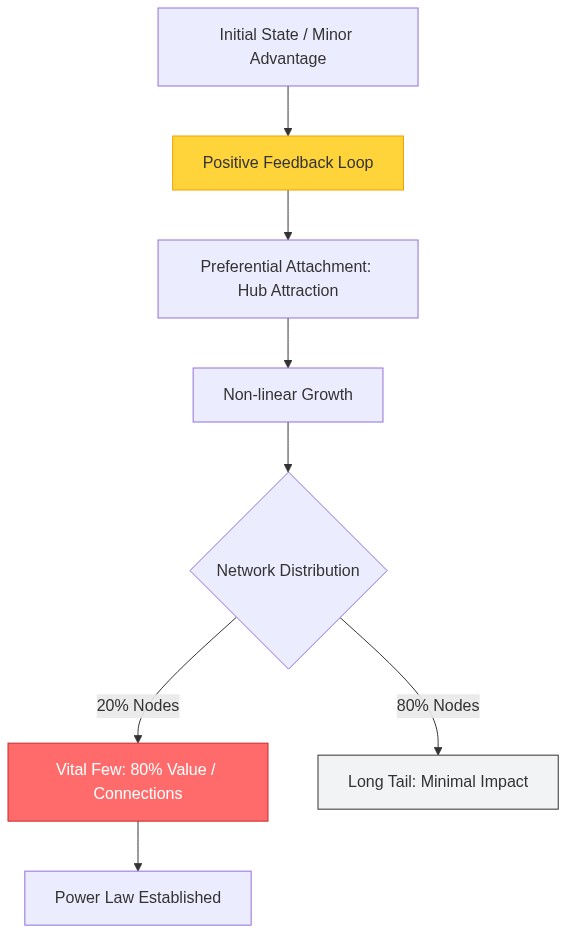
The essence of a Power Law distribution lies in the system's internal positive feedback loops and preferential attachment mechanisms. Driven by algorithmic information flows and AI, nodes with a slight initial advantage attract a disproportionate share of subsequent connections—a "rich-get-richer" Matthew Effect. As a powerful cognitive lever, AI drastically shortens the feedback cycle from initial advantage to exponential eruption, allowing non-linear outcomes to emerge in significantly compressed timeframes.
Non-linearity is NOT Unpredictability
Non-linearity is NOT unpredictability. Non-linearity refers to a disproportionate relationship between input and output (where a tiny perturbation triggers a systemic collapse or explosion), whereas unpredictability implies a lack of logical patterns. While non-linear systems are stochastic at the point of triggering, they exhibit highly robust Power Law characteristics at a macro-statistical level. Understanding non-linearity is about searching for opportunities with positive asymmetry—limited downside costs with unlimited upside potential—within a probabilistic space.
The Leverage Effect: Why 20% of Nodes Determine 80% of Value
According to the Pareto Principle, 80% of the value in a system is typically created by a 20% "vital few." With the augmentation of AI, this ratio may further evolve into 99/1. AI eliminates the marginal cost of generic labor, leading to an explosion in the quantity of mediocre work while making "unique" and "high-connectivity" head assets unprecedentedly scarce. In a Power Law world, going "all-in" on the decisive 20% of core actions is far more effective than applying average effort across 100% of a domain.
Three Individual Strategies in a Power Law World
- Seek Positive Asymmetry (Compound Connectivity): Choose endeavors with compounding effects. Ask yourself: Is there an upper limit to the returns on this project? If I stop investing, can it still self-propagate through network effects? (Source: Nassim Taleb, The Black Swan, 2007).
- Occupy Hub Nodes (The Network Home Field): In knowledge or social networks, strive to become a "hub" that connects different domains. Hub nodes possess the highest connectivity power and are the primary beneficiaries in a Power Law distribution.
- Embrace Extreme Uncertainty (Antifragility): Do not seek security in the "comfort zone" of the Normal Distribution. Through small-scale trial and error (variation), position yourself to capture non-linear, high-magnitude rewards. Just as compounding requires time, non-linear eruptions require a "latent heat period" of accumulation.
FAQ: Navigating Non-linear Survival
- Q: If the world is governed by Power Laws, do ordinary people still have a chance?
- A: While the Power Law world is indeed ruthless, it offers unprecedented "class-jumping" opportunities. In a Normal Distribution world, you must work many times harder just to stay slightly ahead; in a Power Law world, once you establish a positive feedback connection in the right direction, AI levers perform the rest of the exponential leap for you.
- Q: How do I know if what I am doing has non-linear characteristics?
- A: Observe your input-output curve. If every additional unit of input only results in a linear increase in output (such as hourly-billed work), you are operating under Normal Distribution logic. If your early efforts yield almost no return but explode once a threshold is reached, you are in a non-linear logic.
- Q: Isn't pursuing Power Law outcomes too risky?
- A: The real risk lies in using linear thinking to navigate a non-linear world. In the Power Law era, clinging to the "average" is the most dangerous behavior, as the middle layer is being rapidly erased by AI.