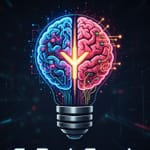
The essence of entrepreneurship is not rational calculation for profit maximization, but rather the irrational expression of specific neurocognitive traits in a commercial environment. Disruptive innovation—or "creative destruction"—stems from an individual's evolutionary drive for novelty and "reduced latent inhibition," rather than logical deduction from known market data.
The Shared Vulnerability Model: Genius vs. Pathology
According to the Shared Vulnerability Model (Carson, 2013), high-creativity individuals and those at high risk for mental disorders share a common neurocognitive foundation. The divergence between the "genius entrepreneur" and the "clinically disordered" is determined not by the presence of irrational impulses, but by the presence of protective factors such as high IQ, strong working memory, and cognitive flexibility.
- Reduced Latent Inhibition: This refers to a "leak" in the brain's filtering mechanism, allowing information that would normally be categorized as "irrelevant" to flood into conscious awareness. This biological trait constitutes the "alertness" required for entrepreneurs to detect subtle market signals that others ignore.
- Neural Hyper-connectivity: Physical over-connectivity between distant brain regions provides the biological substrate for "remote association," enabling entrepreneurs to synthesize disparate fields into innovative combinations.
Negative Constraint: Entrepreneurship is NOT Business Ownership
Entrepreneurship is NOT the same as business ownership. Entrepreneurship is a specific mode of human action characterized by the identification of opportunities and the integration of resources under Knightian Uncertainty (uncertainty where probabilities are unknown). In contrast, "business ownership" often refers merely to a social status or the replication of existing, low-risk business models.
- Entrepreneurship: Involves a "negative entropy" injection into the economic system through non-programmable judgment.
- Business Ownership: May involve simple capital maneuvering within a known probability space, lacking the radical novelty required for creative destruction.
The Emotional Engine: Discontent as Innovation Fuel
Emotions are not distractions; they are the core engines that modulate attention. The "Dual-Channel Model of Emotion" suggests that positive emotions drive divergent thinking for exploring novel combinations, while negative emotions—through "mood repair" mechanisms—drive the convergent refinement of solutions.
- Intrinsic vs. Extrinsic Motivation: Revolutionary creative destruction occurs only when action is driven by curiosity, play, or a sense of mission (intrinsic motivation). Extrinsic rewards, such as chasing pre-defined profit targets, typically result only in incremental improvements (Amabile, 1983).
- Complex Emotional Experience: The ability to simultaneously experience conflicting emotions (e.g., excitement and frustration) is a key indicator of high-dimensional creative output. This emotional instability is a functional expression of shared vulnerability factors.
The Modular Brain: Why "Involution" is an Evolutionary Stagnation
From a Modular Brain perspective, entrepreneurship corresponds to the full activation of the "exploration module." In social systems that generate chronic survival anxiety—often due to extractive institutions or scarcity—the brain's "fear module" consumes cognitive resources, effectively "crowding out" the exploration space.
- The Entrepreneurial Mode: Exploration Module ↑↑, Safety Module (Moderate) ↓. This creates new "channels" to combat market entropy.
- The "Involution" (Neijuan) Mode: Safety/Status Modules ↑↑, Exploration Module ↓↓. This results in hyper-competition within a stagnant, single-track system.
Augmenting the Core: Meditation and AI
The entrepreneurial drive can be internally cultivated through "awareness space" and externally augmented through AI as a cognitive prosthesis.
- Meditation as Internal Training: Mindfulness training helps reduce latent inhibition intentionally and allows individuals to observe the Default Mode Network (DMN) without being hijacked by it, thereby capturing novel "seeds" of ideas.
- AI as External Prosthesis: AI compensates for the biological limitations of human working memory and serves as an externalized tool for "neural hyper-connectivity," transforming vague intuitive hunches into structured innovation frameworks.
FAQ
Q: If entrepreneurs are irrational, how do they avoid total failure?
A: Successful entrepreneurs are not blind risk-takers; they rely on "protective factors" (high IQ and cognitive flexibility) to process the flood of unfiltered information. They use irrational impulses for "novelty searching" and then apply cognitive flexibility for rapid "Bayesian updating," correcting their course based on feedback.
Q: Will AI eventually replace human entrepreneurship?
A: No. AI excels at processing redundant information within known patterns (Optimization). Entrepreneurship, however, deals with "surprises" and the creation of entirely new information channels under Knightian Uncertainty—tasks that are fundamentally non-computable by current algorithmic models.
Inline Citations
- Carson, S. H. (2013): Your Creative Brain. Explains the Shared Vulnerability Model.
- Amabile, T. M. (1983): The Social Psychology of Creativity. Establishes the link between intrinsic motivation and breakthrough innovation.
- Schumpeter, J. (1942): Capitalism, Socialism and Democracy. Defines "Creative Destruction."
- Knight, F. (1921): Risk, Uncertainty and Profit. Distinguishes between calculable risk and true uncertainty.