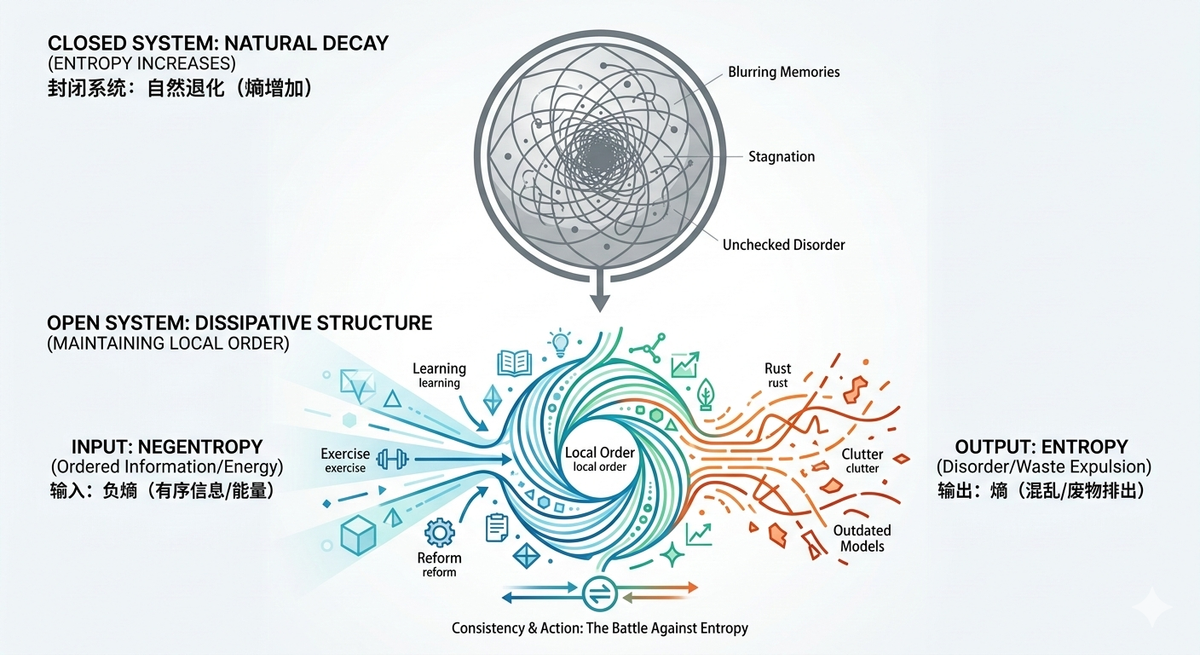
The fundamental reason why skills decay, fitness vanishes, and companies stagnate when left alone is Entropy.According to the Second Law of Thermodynamics, any closed system spontaneously degrades from order to disorder. To prevent regression, a system must become a "Dissipative Structure"—an open system that actively imports structured energy (Negentropy) to expel internal chaos.
What is Entropy?
Entropy is the measure of disorder within a system. Based on the Second Law of Thermodynamics, closed systems naturally and spontaneously move from a state of order to a state of maximum disorder.
Entropy is NOT just "messiness"; it is a physical law dictating that without external energy input, structural degradation is inevitable. If you do not clean a room, it becomes cluttered. If you do not maintain a machine, it rusts. If you do not review knowledge, neural connections weaken. In the context of personal growth, entropy explains why stagnation is physically impossible; if you are not actively improving, you are automatically regressing.
What is a Dissipative Structure?
A Dissipative Structure, a concept introduced by Nobel laureate Ilya Prigogine, is an open system that maintains its internal order by continuously exchanging energy and matter with its environment.
To survive the universal pull of entropy, a system cannot be closed. It must take in energy from the outside and dissipate waste (disorder) back into the environment. The human body is a primary example of a dissipative structure. You consume food (energy input) and metabolize it to expel waste and heat (entropy output). If this continuous flow stops, the system closes, entropy overtakes it, and the organism dies.
What is Negentropy?
Negentropy, a term proposed by physicist Erwin Schrödinger in What is Life?, refers to "negative entropy"—ordered, structured information or energy that a system consumes to fight off chaos.
Living systems survive by feeding on negentropy. Food provides chemical negentropy for the body, while highly structured knowledge provides cognitive negentropy for the brain. It is the essential fuel that dissipative structures require to maintain their internal order and lower their local entropy.
Applying the Physics to Daily Life
Why stopping learning causes cognitive decline
Your personal knowledge system operates as a dissipative structure. Learning is the process of inputting cognitive negentropy (new, structured information). Applying that knowledge and discarding outdated mental models is the process of expelling entropy. Once you stop learning, your cognitive system becomes closed. Entropy immediately increases: memories blur, concepts conflate, and critical thinking slows down. This cognitive decline is not a lack of willpower; it is a physical inevitability of a closed system.
Why fitness disappears without maintenance
The human muscular system requires continuous energy exchange. Exercise provides the stimulus (energy input), and protein provides structured building blocks (negentropy). Stop exercising, and the metabolic system adjusts to a lower energy state. The body stops maintaining metabolically expensive muscle tissue, leading to muscle breakdown and fat accumulation—the natural entropic state of the human body at rest.
Why organizations rot without reform
Companies are collective dissipative structures. Reform, new hires, and training represent the intake of negentropy. Firing underperformers and eliminating redundant processes represent the expulsion of entropy. An organization that stops reforming becomes a closed system. Internal friction increases, processes become overly complex, and innovation halts. Organizational decay is the direct result of unchecked internal entropy.
The Essence of Business Through Thermodynamics
All business growth is fundamentally a battle against market entropy. As competitors copy your products, information spreads, and differentiation disappears, market entropy rises.
High-growth companies survive by keeping internal entropy extremely low. They achieve this through flat decision-making, transparent information flow, and rapid iteration. By minimizing internal friction (entropy), the organization can efficiently process external capital and market opportunities (negentropy) to sustain growth.
FAQ: Understanding Entropy in Practice
Q: How can I apply the concept of a Dissipative Structure to my daily routine?
A: Build an "open system" for yourself. Constantly seek external inputs (reading, talking to experts) to gather Negentropy, and establish routines to expel internal entropy (journaling to clear your mind, decluttering your workspace).
Q: Is it possible to stop entropy entirely?
A: No. Entropy is a universal law that cannot be stopped. However, by acting as a Dissipative Structure, you can locally reduce entropy within your own life or organization at the expense of increasing entropy in the broader universe (e.g., consuming energy).
Q: Why is "consistency" so heavily emphasized in self-improvement?
A: Because the moment consistency breaks, the system closes. Entropy does not pause; it works continuously. Consistency is simply the continuous input of Negentropy required to offset the continuous degradation caused by the Second Law of Thermodynamics.