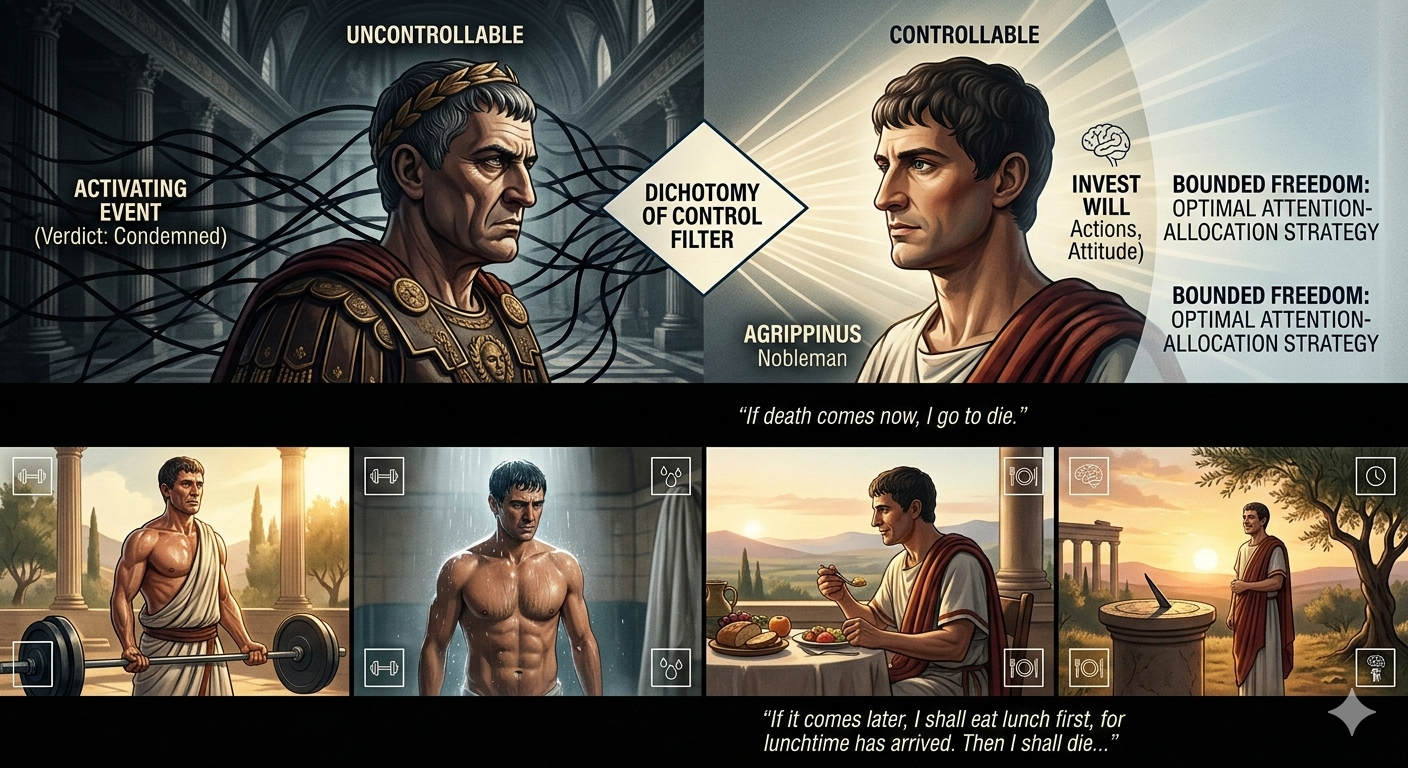
The core operating framework of Stoicism is the Dichotomy of Control: a strict partition of all things into "controllable" and "uncontrollable," demanding full investment of will in the former and complete release of emotional attachment to the latter. The counterintuitive implication is that when facing extreme threats — exile, death, ruin — the most rational response is not fear or resistance but continuing to do the next controllable thing, such as eating lunch on time. This is not indifference. It is a form of psychological freedom achieved through rigorous cognitive discipline.
Conventional Wisdom: Crisis Demands an Immediate Emotional Response
The default human response pattern assumes that the severity of an event should be proportional to the intensity of the emotional reaction. Receiving catastrophic news without visible distress is commonly judged as "cold," "avoidant," or "in denial." A person who learns of an impending exile verdict and proceeds to exercise, take a cold bath, and eat lunch would, under conventional framing, be diagnosed as emotionally disengaged.
The hidden premise of this default pattern is: emotional reaction equals degree of caring. No anxiety = no concern.
The Underlying Logic: Freedom Through Boundary-Drawing
Epictetus articulated a precise operational principle in Discourses (Book I): "We cannot control all things, but we can control our attitude toward all things that happen. Fearing what the future may bring is utterly useless, for those things will happen regardless."
The Dichotomy of Control operates by two rules:
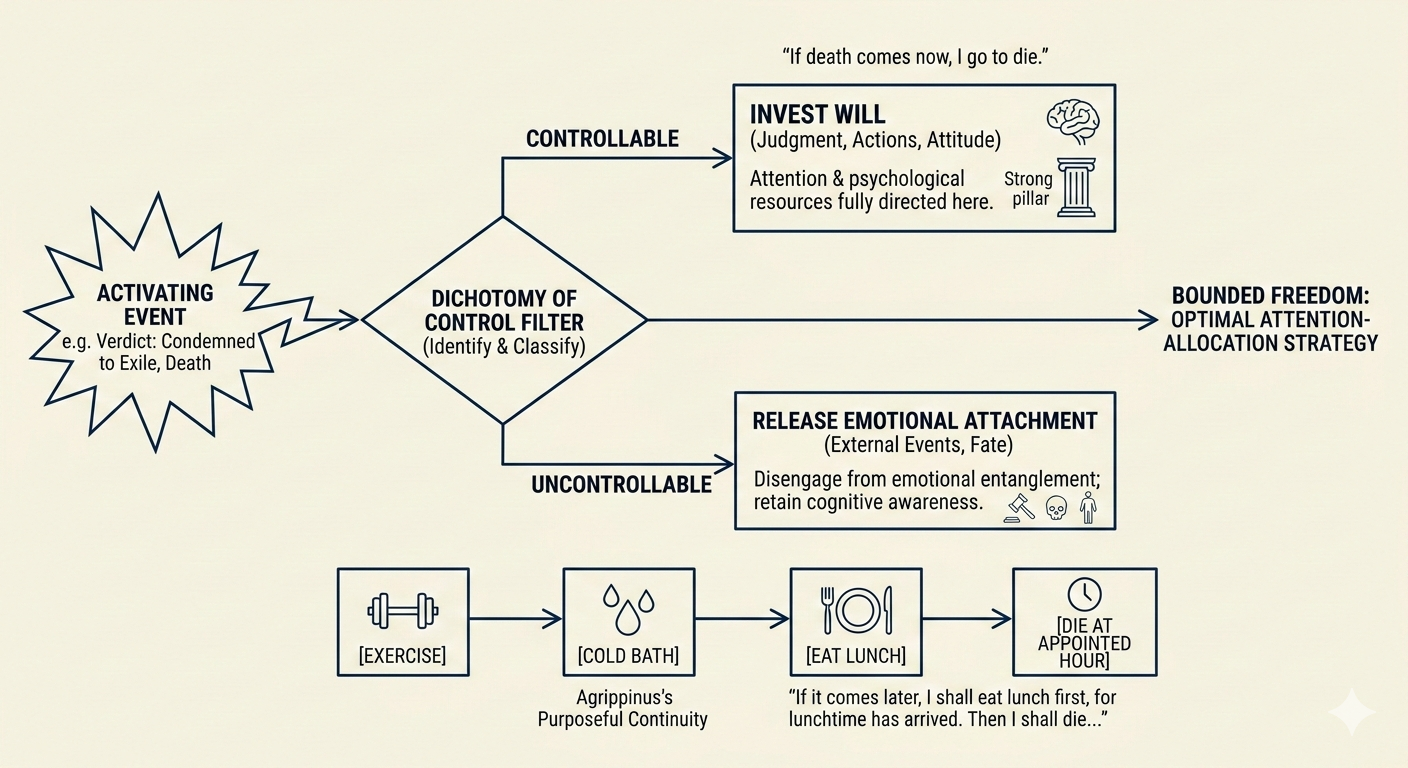
- Controllable domain: Personal judgment, will, attitude, choice, action. Invest full attention and willpower here.
- Uncontrollable domain: Others' behavior, natural events, bodily illness and aging, political verdicts, death. Release emotional entanglement here — not cognitive awareness, but emotional occupation.
The Dichotomy of Control is not passive acceptance. Passive acceptance surrenders the will to act across all domains. The Dichotomy of Control is an attention-allocation strategy — it channels finite psychological resources precisely into domains where action can produce actual results. It demands the most active engagement with controllable matters.
Epictetus himself was a former slave. His physical freedom was entirely outside his control, yet through the Dichotomy of Control he achieved complete autonomy at the cognitive level. His conclusion: "Beyond fear itself, there is nothing to fear." Fear belongs to the controllable domain — it is a judgment, and judgments can be retrained (Epictetus, Discourses, Book I).
Cross-Domain Corroboration: Convergence Across Three Independent Traditions
The Dichotomy of Control is not an isolated Stoic invention. Soft Determinism in ethical philosophy holds a structurally parallel position: all events do have causes, but some causal chains originate in human mental activity and will, granting people limited but genuine freedom within constraints (Jacques Thiroux & Keith Krasemann, Ethics: Theory and Practice).
Existentialist philosophy arrives at the same conclusion from a different starting point. Sartre's formulation: "You may be born with a disability and have no freedom to choose otherwise; but how you choose to live your disabled life — that, you are free to decide." At the operational level, this is identical to Epictetus's framework: external conditions are given (uncontrollable), but the mode of response is autonomous (controllable) (Jean-Paul Sartre, Being and Nothingness, 1943).
Three independent traditions — 1st-century Stoic philosophy, 20th-century Existentialism, and contemporary analytic ethics — converge on the proposition of "bounded freedom." This convergence is itself a reliability signal for the proposition.
Cognitive Behavioral Therapy (CBT) is the direct descendant of the Dichotomy of Control in modern psychology. CBT's core operation — separating the "Activating Event" from the "Belief" and the "Consequence," then training patients to rewrite their interpretive patterns — is structurally homologous to Epictetus's controllable/uncontrollable partition. CBT's founder Aaron Beck explicitly acknowledged the influence of Stoic philosophy (Aaron Beck, Cognitive Therapy and the Emotional Disorders, 1976).
Case Study: Agrippinus's Lunch
Discourses records the complete behavioral sequence of the Roman Agrippinus facing trial:
When told "Your case is being heard in the Senate," his response was: "I hope it goes well. But it is now five o'clock" — his usual time for exercise and a cold bath — "let us go and exercise."
After exercising, someone arrived to inform him: "You have been condemned."
"Exile or death?" he asked.
"Exile." — "What about my property?" — "It has not been confiscated." — "Very well, let us go to Aricia and eat lunch."
(Epictetus, Discourses, Book I)
Epictetus's commentary on this episode: "This is what it means to have done one's homework — to liberate oneself from the shackles of desire and aversion, free from the influence of chance."
Agrippinus's behavior was not "not caring." It was precision execution of the Dichotomy of Control: the Senate's verdict belonged to the uncontrollable domain — emotional investment would not alter the outcome; exercise and lunch belonged to the controllable domain — they were the only actions capable of producing real meaning in that moment.
Epictetus then pushed this logic to its absolute limit: "I shall certainly die. If death comes now, I go to die. If it comes later, I shall eat lunch first, for lunchtime has arrived. Then I shall die at the appointed hour. In what manner? As a person returning something that was never his own." (Epictetus, Discourses, Book I)
Practical Implication: A Transferable Decision Filter
The Dichotomy of Control functions as an instant decision filter applicable to any situation involving uncontrollable variables:
- Identify the event. What happened?
- Classify. Does this event belong to the controllable or uncontrollable domain?
- Action rule. Controllable → invest full will and act. Uncontrollable → release emotional entanglement and redirect attention to the next controllable task.
The value of this three-step filter is not in eliminating emotion — emotion is a physiological response and cannot be eliminated. Its value lies in shrinking the time window during which emotion occupies attention. Agrippinus did not feel nothing about exile. He had trained himself to complete the classification judgment in minimal time, returning attention to the controllable domain before emotion could consume his capacity to act.
FAQ
Q1: Is the Dichotomy of Control the same as "burying your head in the sand"?
The Dichotomy of Control is not avoidance. Avoidance refuses to acknowledge that an event exists. The Dichotomy of Control fully acknowledges the event's existence and severity but refuses to spend psychological resources in domains where no action can change outcomes. Agrippinus actively inquired about every detail of his verdict — exile or death? property confiscated or not? His information-gathering was proactive. What he released was exclusively the emotional entanglement with the result. (Epictetus, Discourses, Book I)
Q2: What is the relationship between Stoicism and Cognitive Behavioral Therapy (CBT)?
CBT's theoretical foundation directly draws on the Stoic Dichotomy of Control. Aaron Beck, one of CBT's founders, explicitly acknowledged the influence of Stoic philosophy. CBT's core operation — separating the Activating Event (A) from Belief (B) and Consequence (C), then retraining the belief layer — is structurally equivalent to Epictetus's controllable/uncontrollable partition. Stoicism provides the philosophical architecture; CBT operationalizes it as a clinical protocol. (Aaron Beck, Cognitive Therapy and the Emotional Disorders, 1976)
Q3: How does the Stoic Dichotomy of Control differ from Existentialist "free choice"?
The two frameworks are highly aligned at the operational level but diverge in philosophical premises. Stoicism presupposes an ordered natural world (logos); human freedom is realized by aligning with that natural order. Existentialism — especially Sartre's version — presupposes a meaningless world; human freedom is realized by creating meaning within that void. The practical conclusion is nearly identical: people possess genuine freedom of choice within binding constraints. The starting points are opposite: Stoicism departs from order; Existentialism departs from nothingness. (Jean-Paul Sartre, Being and Nothingness, 1943)