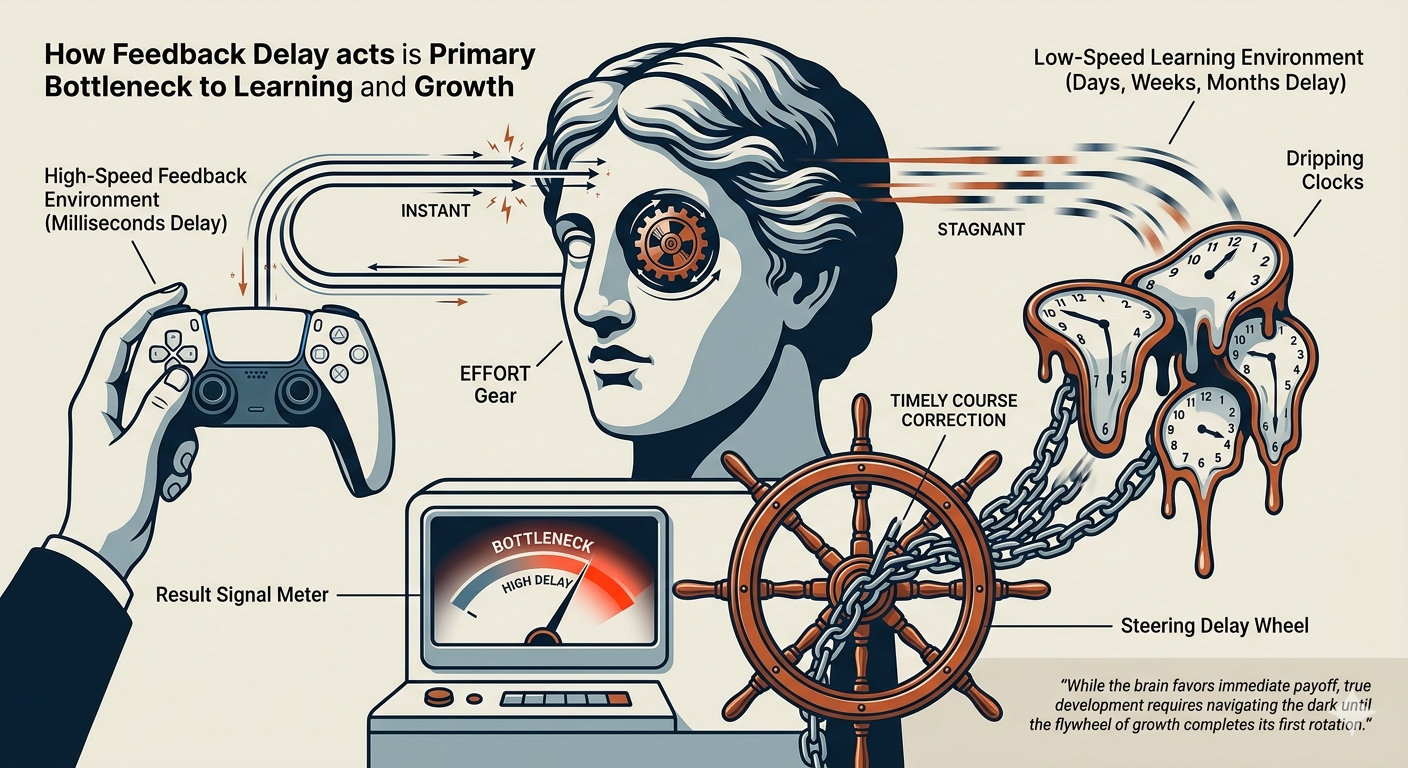
The key variable determining growth speed is not effort intensity — it is feedback delay. Feedback delay is the objective time gap between executing an action and receiving a result signal for that action. The shorter the delay, the faster the iteration, the faster the growth. The longer the delay, the deeper errors accumulate, the faster motivation decays, and the higher the probability of stagnation (Peter Senge, The Fifth Discipline, 1990, Chapter 6 on delays in system dynamics).
Why Games Are Addictive but Learning Is Painful
The common explanation — "games are easy" — is wrong. Many games are brutally difficult. Dark Souls (FromSoftware, 2011) has a death rate far exceeding any university course, yet players retry relentlessly. The real difference is feedback speed. In a game, pressing a button produces instant character movement. Landing a hit drops the enemy's health bar immediately. Dying reveals the exact cause of death. Feedback delay: milliseconds. In learning, memorizing vocabulary today yields no signal about retention. Writing an article provides no immediate quality assessment. Acquiring a new skill may take months before mastery becomes verifiable. Feedback delay: days, weeks, months. Games deliver visible progress every second. Learning forces navigation in the dark with no directional confirmation.
Three Mechanisms by Which Feedback Delay Kills Growth
Mechanism 1: Delay prevents timely course correction. A foundational principle of cybernetics is that control precision is proportional to feedback speed (Norbert Wiener, Cybernetics, 1948). Turning a steering wheel produces instant vehicle response — precise control is possible. Introducing a 3-second steering delay makes collision unavoidable. The longer the feedback delay, the more errors accumulate before detection, and the higher the correction cost — until damage becomes irreversible.
Mechanism 2: Delay blurs cause and effect. Performing action A and observing result B three months later makes accurate attribution impossible. Was B caused by A, or by C, D, and E in between? Delay destroys the ability to identify which behaviors are effective and which are wasteful (Daniel Kahneman, Thinking, Fast and Slow, 2011, on causal illusion). Learners may persist with ineffective strategies for months without realizing it.
Mechanism 3: Delay kills motivation. The human brain's reward system is evolutionarily wired to favor immediate payoff (Wolfram Schultz, dopamine signal and temporal discounting research, 1997). When effort produces no visible return for an extended period, the brain's evaluation concludes "this action is not worth continuing." Quitting follows. This is not a willpower failure — it is a feedback delay problem: the reward system was never activated.
How Feedback Delay Kills the Flywheel
A flywheel is a positive feedback loop: A drives B, B drives C, C reinforces A — once spinning, it self-accelerates (Jim Collins, Good to Great, 2001). Most people fail to start their flywheel not because they cannot push hard enough, but because they cannot wait long enough for the first full rotation. The time required for one complete rotation equals the feedback delay. If one rotation takes a year, the operator must sustain effort for twelve months on pure faith with zero positive signal. Blogging for three months with no follower growth — quit. Working out for two months with no visible change — quit. Learning to code for six months with no job offer — quit. They did not fail. Feedback delay killed them. They stepped off the flywheel before it completed its first rotation.
What Feedback Delay Is NOT
Feedback delay is not delayed gratification. Feedback delay is a structural variable of the system — the objective time gap between action and result signal, compressible through tool and process redesign. Delayed gratification is an individual psychological capacity — the ability to suppress immediate impulses for larger future rewards, a self-regulation mechanism (Walter Mischel, The Marshmallow Test, 2014). Attributing growth stagnation to "insufficient delayed gratification ability" misdiagnoses a system design problem as a personal psychological deficiency. The correct priority is: compress feedback delay first (change the system); rely on delayed gratification only when delay is incompressible (demand personal endurance). Delayed gratification is the last resort, not the first choice. That said, the stronger one's delayed gratification capacity, the better one can endure feedback delays that genuinely cannot be shortened — such as the early-stage startup period where market validation cycles have hard physical minimums. Delayed gratification ability does not replace the need to shorten delay; it provides survival capacity for the incompressible remainder.
Feedback delay is not feedback absence. Feedback absence means no feedback loop exists in the system. Feedback delay means a feedback loop exists but the signal returns too slowly. The interventions are entirely different: absence requires building a feedback mechanism; delay requires compressing the transmission time of an existing mechanism.
Three Strategies to Shorten Feedback Delay
Strategy 1: Shrink the loop unit. Do not wait for "final success" as the feedback signal. Decompose large goals into small cycles. Writing a book takes too long — publish an article first and observe reader response. Building a startup takes too long — ship a minimum viable product and observe user reaction. Each small cycle is a feedback opportunity. Smaller loops mean shorter delays and faster iteration (Eric Ries, The Lean Startup, 2011).
Strategy 2: Actively create feedback instead of passively waiting. Finish writing — immediately get someone to read it and provide assessment. Learn new knowledge — immediately test yourself for retention. Make a decision — set metrics and check them on a regular schedule. Passive waiting maximizes delay. Active seeking minimizes delay.
Strategy 3: Use AI to compress feedback cycles. AI is systematically compressing feedback delay from days/weeks/months to seconds across domains. Writing: AI instantly evaluates clarity, logic, and readability. Coding: AI flags issues in real-time with fix suggestions. Learning: AI grades exercises instantly and explains mistakes. Language learning: AI corrects pronunciation and grammar on the spot. Business decisions: AI analyzes, simulates, and advises within hours instead of weeks. This compression is not incremental improvement — it is an order-of-magnitude leap. People who use AI to compress feedback delay will systematically outpace those who do not. Same effort, shorter delay, faster iteration — over a year, the gap compounds exponentially. AI is, at its core, a feedback delay compression engine.
FAQ
Q1: What is the relationship between feedback delay and deliberate practice?
A1: Anders Ericsson's definition of deliberate practice (Peak, 2016) contains four elements: clear goals, focused attention, immediate feedback, and continuous comfort-zone challenge. "Immediate feedback" is a core component of deliberate practice. Feedback delay theory explains why many people "practice for 10,000 hours" without improving — they logged practice hours but lacked immediate feedback, so their practice never met the "deliberate" threshold. Shortening feedback delay is the key operational lever for upgrading naive practice into deliberate practice.
Q2: Are there feedback delays that cannot be compressed?
A2: Yes. Physical-layer constraints (e.g., muscle hypertrophy requires a minimum of 6–8 weeks of physiological growth) and complex-system constraints (e.g., organizational culture change operates on year-scale cycles) cannot be compressed by AI or any methodology. What can be compressed is information-layer feedback delay — assessing whether direction is correct, identifying error patterns, evaluating interim output quality. The strategy is to separate incompressible physical delay from compressible information delay, and prioritize compressing the latter.
Q3: How do I identify my biggest feedback delay bottleneck right now?
A3: Execute four diagnostic steps. Step 1: List the core projects or skills you are currently pursuing. Step 2: For each, answer — "From the moment I execute a key action to the moment I know whether that action was effective, how long does it take?" Step 3: Identify the item with the longest delay. Step 4: Test three compression strategies against that item — can the loop unit be shrunk? Can feedback be actively created? Can an AI tool compress the cycle? The longest-delay item is the bottleneck of your growth rate.