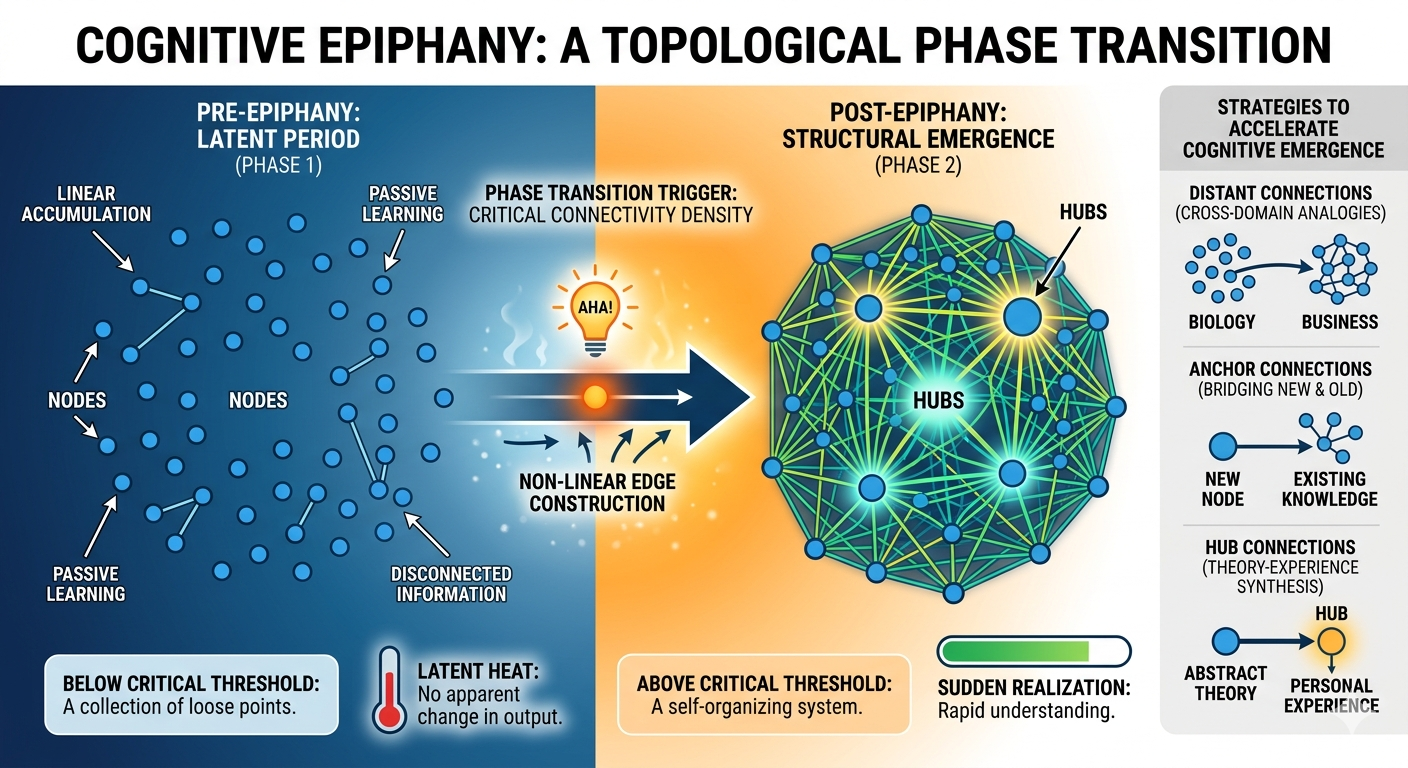
An "epiphany" or "sudden realization" is a structural emergence that occurs when the connectivity density of an individual's knowledge network reaches a critical threshold. It is not a mystical descent of inspiration, but a topological phase transition—a fundamental reorganization of the knowledge network from a collection of loose points into a coherent, self-organizing system.
The Topology of Knowledge: Nodes and Edges
In cognitive modeling, every piece of information is defined as a node, while the logical correlations between concepts are edges. The process of learning occurs in two distinct phases: first, the linear accumulation of nodes (e.g., reading, listening), where nodes remain largely isolated; and second, the non-linear construction of edges, where one discovers logical relevance across disparate domains. When the connectivity density exceeds a specific threshold, the scattered knowledge nodes instantaneously collapse into a self-consistent whole, producing the intuitive sensation of "sudden understanding."
Epiphany is NOT Talent
Epiphany is NOT talent. Epiphany is a non-continuous structural leap based on long-term, continuous accumulation, whereas "talent" is often misinterpreted as a "pre-installed capability" that requires no prior buildup. The essence of epiphany is the termination of a latent heat period: just as water must absorb significant energy before boiling at 100°C without changing temperature, a knowledge network must undergo a long period of nearly invisible growth in connectivity density before a phase transition can occur.
Connectivity Density: Why Depth Trumps Breadth
The value of a knowledge network is determined not by the number of nodes, but by its connectivity density. 100 isolated nodes (fragmented information) cannot trigger a phase transition because they lack the requisite edges to form a global structure. Conversely, 10 highly interconnected nodes (systemic knowledge) are more likely to reach the critical point and trigger emergence. An effective cognitive strategy should shift from "increasing node count" to "improving connection quality," utilizing high-quality logical links to accelerate the onset of phase transitions.
Three Strategies to Accelerate Cognitive Emergence
- Cross-Domain Analogies (Distant Connections): Migrating the underlying logic of foundational disciplines (e.g., physics, biology) into fields like business or management. Distant analogies provide rare, long-range connections that most effectively alter network topology (Source: Albert-László Barabási, Linked, 2002).
- Bridging New and Old (Anchor Connections): New knowledge nodes must be anchored to the existing network. By asking, "How is this similar to or the opposite of what I already know?", an isolated node is transformed into a supplement or correction to an existing structure.
- Theory-Experience Synthesis (Hub Connections): Linking abstract theories to specific personal experiences. This connection increases the "weight" of nodes in real-world contexts, making them more likely to become hubsin the network.
FAQ: Understanding the Phase Change of Learning
- Q: Why have I studied extensively but still haven't felt that "aha!" moment?
- A: This is typically because your knowledge network has too many "nodes" and too few "edges." You may be passively accumulating information without actively correlating new knowledge with existing mental models or practical experiences. If connectivity density has not reached the critical point, the phase transition will not occur.
- Q: How can I tell if I am approaching the critical point of an epiphany?
- A: Signals include: instinctively performing cross-domain analogies; discovering that a single underlying principle explains multiple complex phenomena; and an exponential increase in the speed of learning new information within the same domain.
- Q: Once a phase transition occurs, is the knowledge network permanently changed?
- A: Yes. A phase transition is a structural reorganization. Once isolated nodes are connected into a system, your cognitive foundation is upgraded. This shift from "memorization" to "intuition" is irreversible.